Perspectives

Audience members viewing a presentation by MLA student, Bianca LaPaz
PERSPECTIVES 02
The McHarg Center for Urbanism and Ecology this month published Perspectives 02, a series of student-led interviews exploring the underpinnings of faculty research. The center launched the series last year in an effort to share its research with a broader audience, and to strengthen connections between different strands of research, teaching, and design practice within the Weitzman School of Design. The interviews allow student research assistants to investigate the motivations behind the projects they contribute to, and to see how their own work gets incorporated into them, engendering “a sense of responsibility toward the type of knowledge that we’re making and how we’re making it,” as one recent graduate says. Reflecting both the diversity of faculty interests and the wealth of opportunities for student research, Perspectives illustrates the McHarg Center’s centrality to the Department of Landscape Architecture.
Read More
X
PERSPECTIVES 02: Ecological Infrastructures
In 2025, the Weitzman School of Design and the McHarg Center hosted the Designing Multi-Benefit Transmission Corridors workshop and the Designing for Fire symposium at the University of Pennsylvania, both convened by Assistant Professor Nick Pevzner of the Department of Landscape Architecture. These two events traversed different terrains, but both reflect the socio-ecological position motivating his research in applied ecological science for over a decade: engaging complex systems, including energy infrastructural landscapes, carbon removal, and wildfire and forest management, and collaborating with experts beyond the design disciplines.
Read More
X
PERSPECTIVES 02: Landscape as Griot
“Landscape as Griot” is a McHarg Center research project, initiated by Assistant Professor of Landscape Architecture Azzurra Cox, that envisions the post-demolition topographies of Detroit as emergent landscapes of memory. A griot is an individual who acts as both storyteller and keeper of cultural traditions in some West African societies. With this project, Professor Cox is proposing a reading of the landscape itself as an agent that both embodies and narrates its histories. This project has evolved from archival research and a material investigation into a collaborative effort through the introduction of an advanced landscape design studio entitled “Mound City: Remembrance and Rebirth in Detroit.” In the fall of 2025, Professor Cox brought graduate landscape architecture students to Detroit to engage in a critical reading of the mound sites that dot the city, challenging her students to design by centering an ethic of memory and engaging with representations of the city’s layered past. The project explores an idiosyncratic landscape where rich cultural production is juxtaposed with displacement and erasure of the city’s Black history. Cox asks how an archipelago of living, evolving, material memory can remain relevant to Detroit’s future at the scale of the city, the neighborhood block, and the mound sites themselves.
Read More
President's Commission reviewing maps of Three Mile Island
PERSPECTIVES 02: Toward a Toxic-Free Future
To support capacity building in community-led environmental right-to-know research, Assistant Professor Jessica Varner and her graduate student researchers worked alongside community members to develop resources that improve navigation of state laws under the Freedom of Information Act (FOIA). The work is now a publicly available digital resource housed in A People’s EPA (APE), as part of the “Community-Led FOIA" project. The website is dedicated to explaining the nuanced histories of the U.S. Environmental Protection Agency and clarifying its operations and inner workings. APE is affiliated with the Environmental Data & Governance Initiative, a research collaborative advancing environmental right-to-know research that serves as a watchdog organization tracking changes in access to federal environmental information.

Research assistant Bianca LaPaz (MLA ’27) spoke with Dr. Jessica Varner about her role in A People's EPA, the Community-Led FOIA project, and the broader research interests that inform her work, including the long development of synthetic chemicals in U.S. and German corporations, toxicity in the built environment, the importance of public histories, and related environmental justice efforts.
Read More
The Chisos Mountains
PERSPECTIVES 02: CIRCLE
CIRCLE is a group of landscape designers, educators, and scholars who advocate for greater inclusion of Indigenous voices in environmental design and planning. Their collaborative work includes the discussion series “Designing For, By and With: Indigenous Voices of the Land,” hosted by the University of Pennsylvania’s McHarg Center for Urbanism and Ecology and the Department of Landscape Architecture at the California State Polytechnic University, Pomona. This series, held from January to April 2026, brought together eleven speakers from across North America to discuss their work within Indigenous communities. The multi-time-zone, cross-border collaboration held four panels, including “Sovereignty in Design,” “Designing For and From Community,” “Sacred Sites, Storytelling and Memory in Place,” and “Education, Institutions, and the Path Forward.”

CIRCLE was founded by Desiree Martinez, a member of the Gabrielino (Tongva) community and Tribal Relations and NAGPRA/CalNAGPRA Director at Cal Poly Pomona; Muriel Fernandez, a faculty member of the Department of Landscape Architecture at Cal Poly Pomona; Tera Johnson, dual MLA + MCP from University of California, Berkeley now working at the California Botanic Garden; and Dagny Elise Carlsson, a Penn dual-degree MLA / MArch student and a citizen of the Cherokee Nation and Shawnee Tribe.

Rather than a traditional interview, the group conducted a roundtable discussion following the format of their regular meetings. CIRCLE has always functioned in a non-hierarchical, collaborative manner, and thus the roundtable consists of discussion questions intended to encourage reflection on CIRCLE’s collaborative process. Topics included the speaker series, their collective goals, and their hopes for how these discussions might influence design practice more broadly.
Read More
CAPR card deck
PERSPECTIVES 01: Constructing the American Public Realm
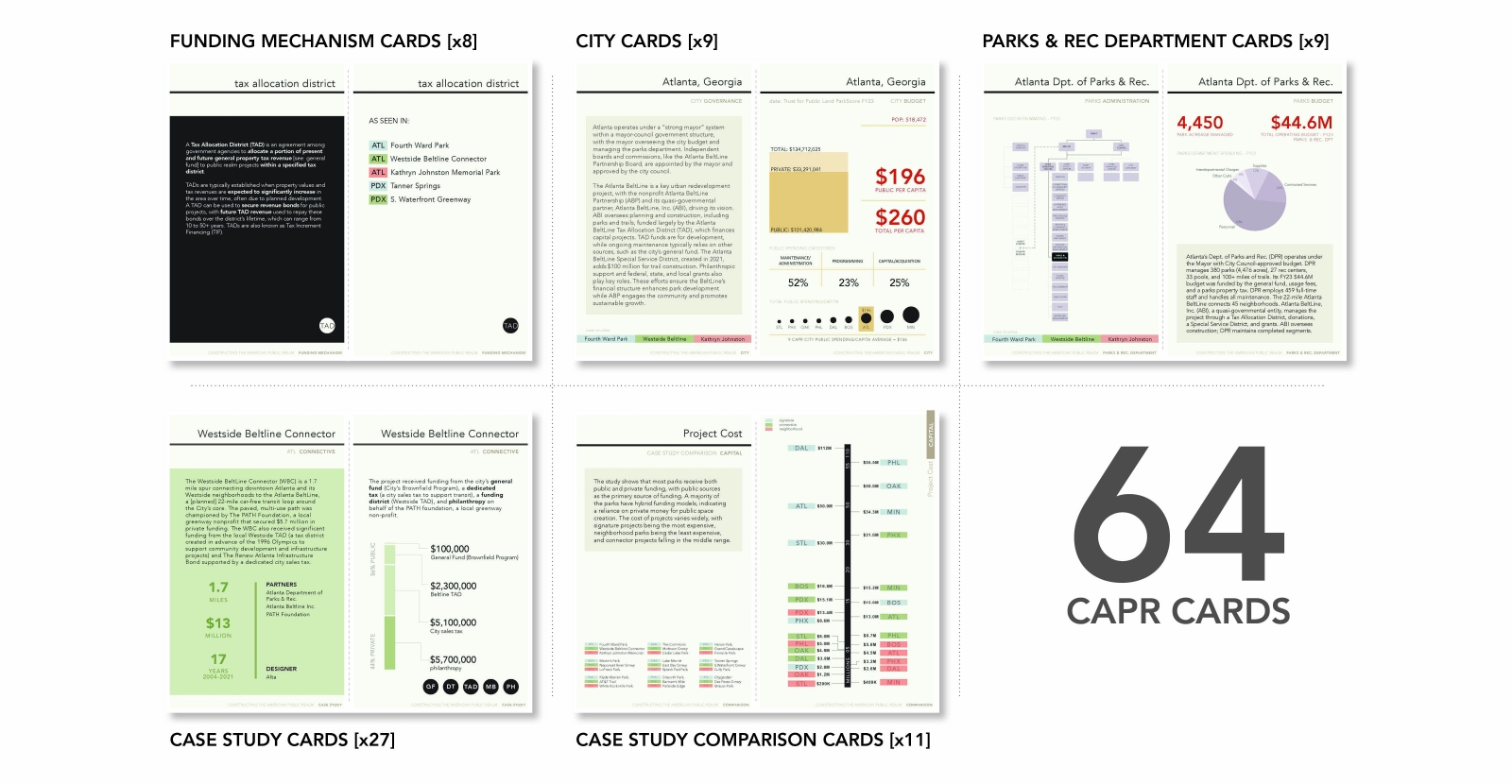
The research project “Constructing the American Public Realm” (CAPR), initiated by Christopher Marcinkoski at the McHarg Center and in ongoing collaboration with the team at PORT Urbanism, examines how Public space is conceived, funded, built, and administrated across nine American cities. CAPR focuses on capital structures and governance models, creating a framework to compare municipal strategies on creating and operating public space, revealing idiosyncrasies in how these processes and investments are deployed. This research led to the creation of a 64-card Public Space Funding Primer—a tool designed to distil complex funding models, governance structures, and investment mechanisms into an accessible format so that people can better understand how public space is made and managed. The cards allow designers, policymakers, and community members to ask “How did other cities get these projects done? How are they paying for this work and structuring projects for long-term success?” CAPR aims to better support advocacy and informed decision-making around the public realm, both in and beyond the design profession.

CAPR has been made publicly accessible through PORT’s design practice and has been presented to professional associations that focus on the built environment and public realm including the National Mayors’ Institute on City Design, the National Recreation and Park Association, the American Institute of Architects, and the American Society of Landscape Architects.

Christopher Marcinkoski sat down with his research assistant and PORT collaborator Lillia Schmidt (MLA ‘25) to discuss this ongoing work.
Read More
Tropical Plants
PERSPECTIVES 01: Adventive America
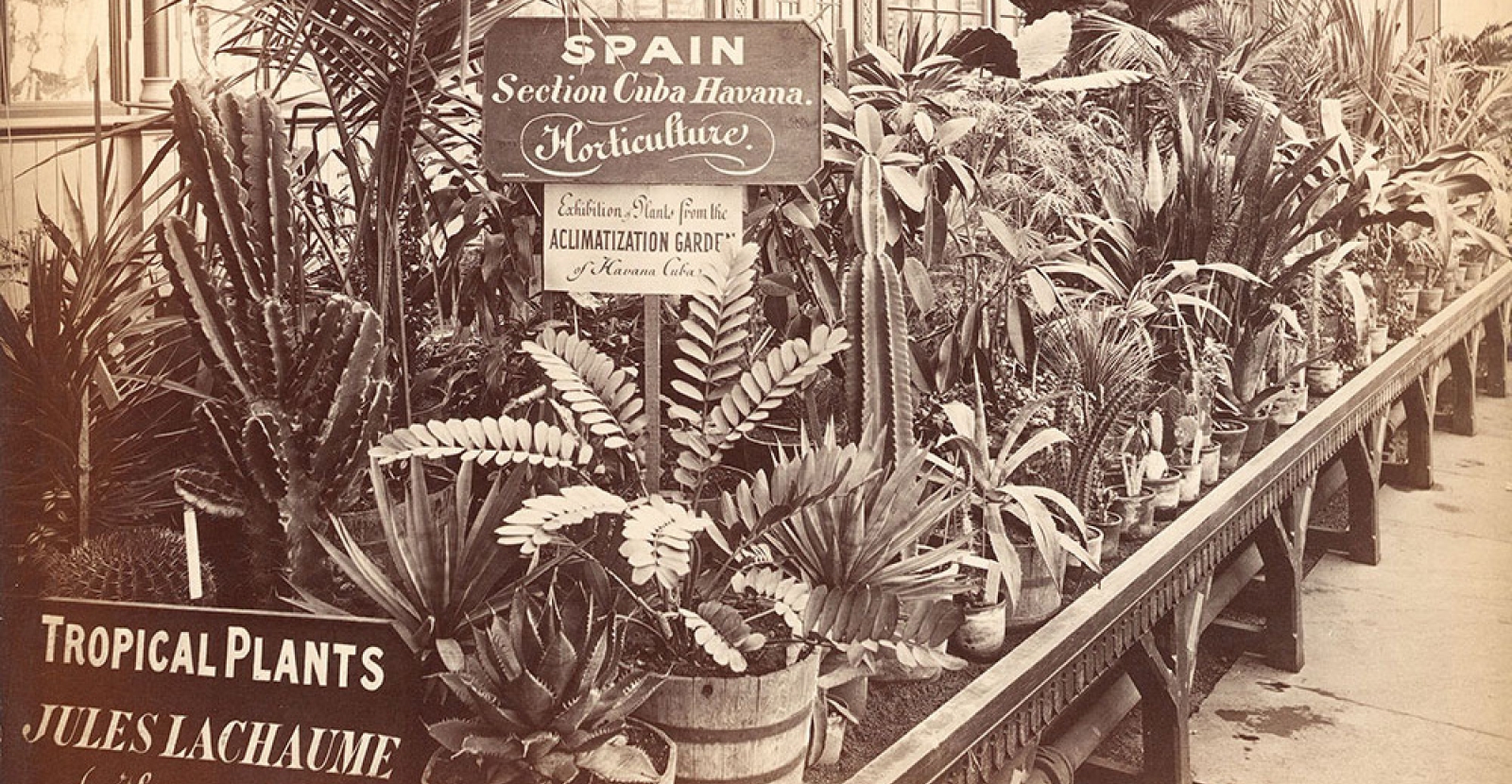
In advance of the 2026 semiquincentennial of the United States, marking the 250 years since the signing of the Declaration of Independence in Philadelphia in 1776, graduate student researchers have been assisting Catherine Seavitt, Meyerson Professor and Chair of the Department of Landscape Architecture, with a McHarg Center project entitled “Adventive America.” The project explores the narratives of the botanical exchanges of the early republic, acknowledges the agency of plants at both the 1876 Centennial Exposition and along the Delaware River’s wasteland shores, and invokes the critical spirit of the grassroots People’s Bicentennial Commission of 1976. The Centennial Exposition, held at Fairmount Park during the aftermath of the Civil War, reveals fascinating threads of international relations and exchange, the global movement of plant materials, and the role of plants in the economic and industrial history of the United States. With the upcoming 250th anniversary in Philadelphia, this project uses a nontraditional lens to think critically about the making of a nation.

Research assistant Elizabeth VanDerwerken (MLA, MCP ’26) spoke with Catherine Seavitt about the ongoing Adventive America project as well as the broader research interests that inform her work.
Read More
Sediment Modeling Table
PERSPECTIVES 01: Tides of Change
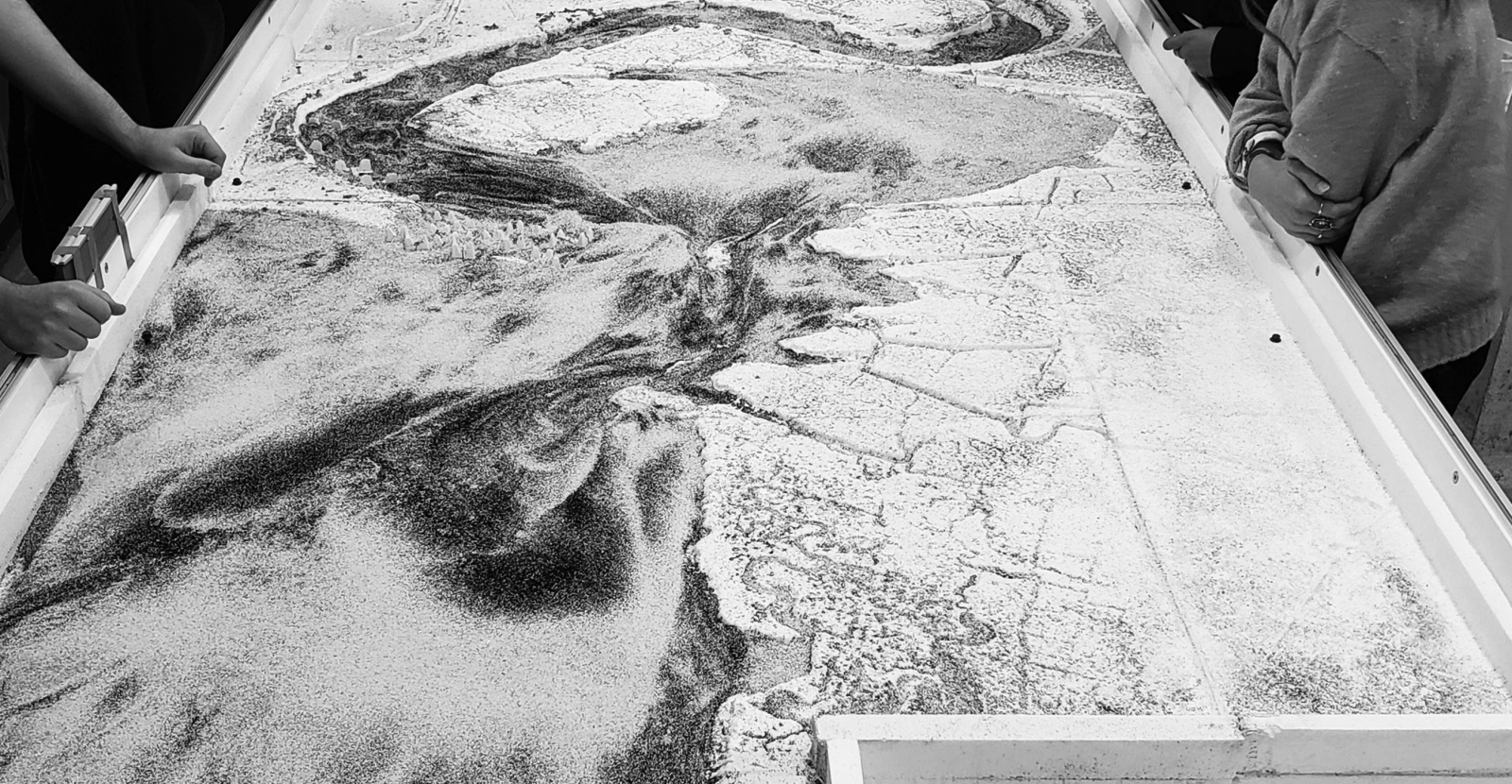
The Environmental Modeling Lab (EMLab) is an applied research unit of the McHarg Center at the University of Pennsylvania, advancing the roles of sensing, simulation, and modeling within the discipline of landscape architecture. The lab specializes in the analysis, simulation, and visualization of coastal landscapes by use of remote sensing, UAV surveys, and ground-truthing fieldwork. Their work bridges the gap between ecological engineering and design fields through the creation of novel environmental datasets, experimental models (digital and physical), and with visual interpretations of complex data. By situating its research at the McHarg Center, the EMLab is able to experiment with novel methodology, and partner with both academic and private-sector collaborators. This intellectual freedom allows the Lab to develop and advance new strategies for protecting and adapting coastlines to the challenges of climate change.

The EMLab’s research touches coastlines from the Great Lakes to the Galápagos, New Jersey to the Gulf Coast. In 2025 the team received a national ASLA Honor Award in Research and a World Landscape Architecture (WLA) award for its modeling and monitoring project “About Time: Adaptive Management for Coastal Salt Marshes,” and is continuing work in collaboration with the University of Auburn, University of Virginia and the US Army Corps of Engineers. More information on the EMLab’s current projects can be found here.

Co-founders Sean Burkholder, Karen M’Closkey, and Keith VanDerSys sat down with EMLab Research Assistants Clarasophia Gust and Mariya Lupandina to discuss the land-water divide in data and technology, the importance of landscape architects’ involvement in creating environmental data, and how an applied research lab within academia can push the landscape discipline to think differently.
Read More
Nursery harvesting tools
PERSPECTIVES 01: Clones Zones and Migrants
This fall, landscape designer and researcher Leah Kahler joined the Weitzman faculty as the 2024-2025 McHarg Fellow. Through multi-sited fieldwork and archival research at the National Agricultural Library, Leah’s work at the McHarg Center documented the expansive socio-ecological geographies of the plant nursery trade. Her research asks how the design and horticultural trades might find new methods for plant selection and sourcing. Kahler’s work reveals the labor and environmental processes that precede a plants’ arrival on a jobsite, re-framing the $13.8-billion US tree and seed nursery industry as an important agent in the material culture of the American built environment. In the spring, Leah taught a graduate-level seminar called “Clones, Zones, and Migrants,” based on her nursery research. This course explored plant migration across cultures and climates, as well as the labor and environmental implications of plant procurement. Through ongoing engagement with professionals and academics, Kahler is encouraging current and future landscape practitioners to reconsider assumptions around the sustainability of landscape construction, “native” planting, and asking how these practices might better align with the field’s aspirations to environmental justice.

Following her culminating lecture titled, “Before a Plant Arrives on Site: Politics, Migrations, and Possibilities of the Plant Nursery Trade,” Leah sat down with one of the students in the seminar, Nitya Patel (MLA ’25) to reflect on the fellowship year.
Read More
Three photos forming landscape
New Ruralism
A call for landscape architects to look across the urban/rural divide and develop methodologies based in the future for areas too often relegated to the past.
Read More

Footnotes