Join our mailing list and receive invitations to our events and updates on our research in your inbox.

This collection of design ideas was generated through an open call to translate the core goals of the Green New Deal—decarbonization, justice, and jobs—into design and planning projects with regional and local specificity. Between August 2020 and June 2021, over 50 groups, over 100 individuals, and 170 university courses representing 90 universities participated in the Green New Deal Superstudio. A complete archive of their submissions is available here. The Green New Deal Superstudio was a joint effort led by the Landscape Architecture Foundation in association with the Weitzman School of Design McHarg Center, the Center for Resilient Cities and Landscapes, the American Society of Landscape Architects (ASLA), and the Council of Educators in Landscape Architecture (CELA).
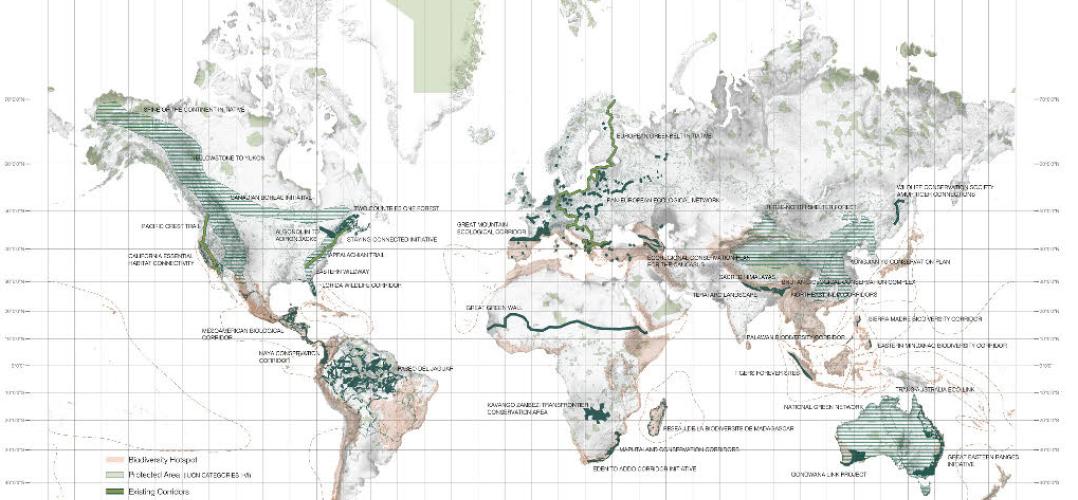
The World Park Project website, concerning a proposal to create a connected and conserved landscape at a planetary scale, was launched in July 2021. This project is now in a phase of peer review and feasibility assesment involving representatives of nations and conservation NGOs with a vested interest in the subject.The World Park was most recently exhibited at the Venice Biennale and presented as part of the IUCN World Conservation Congress in Marseilles.
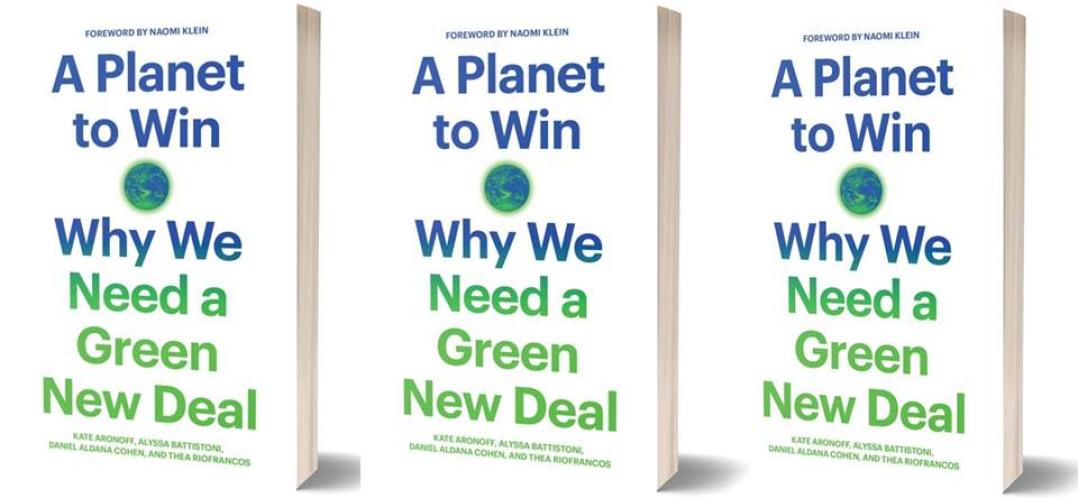
The age of climate gradualism is over, as unprecedented disasters are exacerbated by inequalities of race and class. We need profound, radical change. A Green New Deal can tackle the climate emergency and rampant inequality at the same time. Cutting carbon emissions while winning immediate gains for the many is the only way to build a movement strong enough to defeat big oil, big business, and the super-rich—starting right now.
A Planet to Win explores the political potential and concrete first steps of a Green New Deal. It calls for dismantling the fossil fuel industry, building beautiful landscapes of renewable energy, and guaranteeing climate-friendly work, no-carbon housing, and free public transit. And it shows how a Green New Deal in the United States can strengthen climate justice movements worldwide.
We don't make politics under conditions of our own choosing, and no one would choose this crisis. But crises also present opportunities. We stand on the brink of disaster—but also at the cusp of wondrous, transformative change.
***
Kate Aronoff is a Fellow at the Type Media Center and a Contributing Writer at the Intercept. She is the co-editor of We Own the Future and author of The New Denialism. Her writing has appeared in the Guardian, Rolling Stone, Harper’s, In These Times, and Dissent.
Daniel Aldana Cohen is an Assistant Professor of Sociology at the University of Pennsylvania, where he directs the Socio-Spatial Climate Collaborative, or (SC)2. His writing has appeared in the Guardian, Nature, the Nation, Jacobin, Public Books, Dissent, and NACLA.
Alyssa Battistoni is a Postdoctoral Fellow at Harvard University and an Editor at Jacobin. Her writing has appeared in the Guardian, n+1, the Nation, Jacobin, In These Times, Dissent, and the Chronicle of Higher Education.
Thea Riofrancos is an Assistant Professor of Political Science at Providence College and the author of Resource Radicals. Her writing has appeared in the Guardian, n+1, Jacobin, the Los Angeles Review of Books, Dissent, and In These Times. She serves on the steering committee of DSA’s Ecosocialist Working Group.
Mary Annaïse Heglar is a climate justice essayist and writer. Her essays about climate change have appeared in Vox, Dame Magazine, and Inverse, and she also writes regularly on Medium. She is the director of publications at the Natural Resources Defense Council, and holds a BA in English from Oberlin College. She is based in New York City.
Billy Fleming is Wilks Family Director of the McHarg Center at the University of Pennsylvania. His writing has appeared in the Guardian, Places Journal, Dissent, and Jacobin. He is the co-editor of Design With Nature Now (Lincoln, 2019), An Adaptation Blueprint (Island Press, 2020), and lead author of "The 2100 Project: An Atlas for the Green New Deal."