“Landscape as Griot” is a McHarg Center research project, initiated by Assistant Professor of Landscape Architecture Azzurra Cox, that envisions the post-demolition topographies of Detroit as emergent landscapes of memory. A griot is an individual who acts as both storyteller and keeper of cultural traditions in some West African societies. With this project, Professor Cox is proposing a reading of the landscape itself as an agent that both embodies and narrates its histories. This project has evolved from archival research and a material investigation into a collaborative effort through the introduction of an advanced landscape design studio entitled “Mound City: Remembrance and Rebirth in Detroit.” In the fall of 2025, Professor Cox brought graduate landscape architecture students to Detroit to engage in a critical reading of the mound sites that dot the city, challenging her students to design by centering an ethic of memory and engaging with representations of the city’s layered past. The project explores an idiosyncratic landscape where rich cultural production is juxtaposed with displacement and erasure of the city’s Black history. Cox asks how an archipelago of living, evolving, material memory can remain relevant to Detroit’s future at the scale of the city, the neighborhood block, and the mound sites themselves.
PERSPECTIVES 01: Constructing the American Public Realm
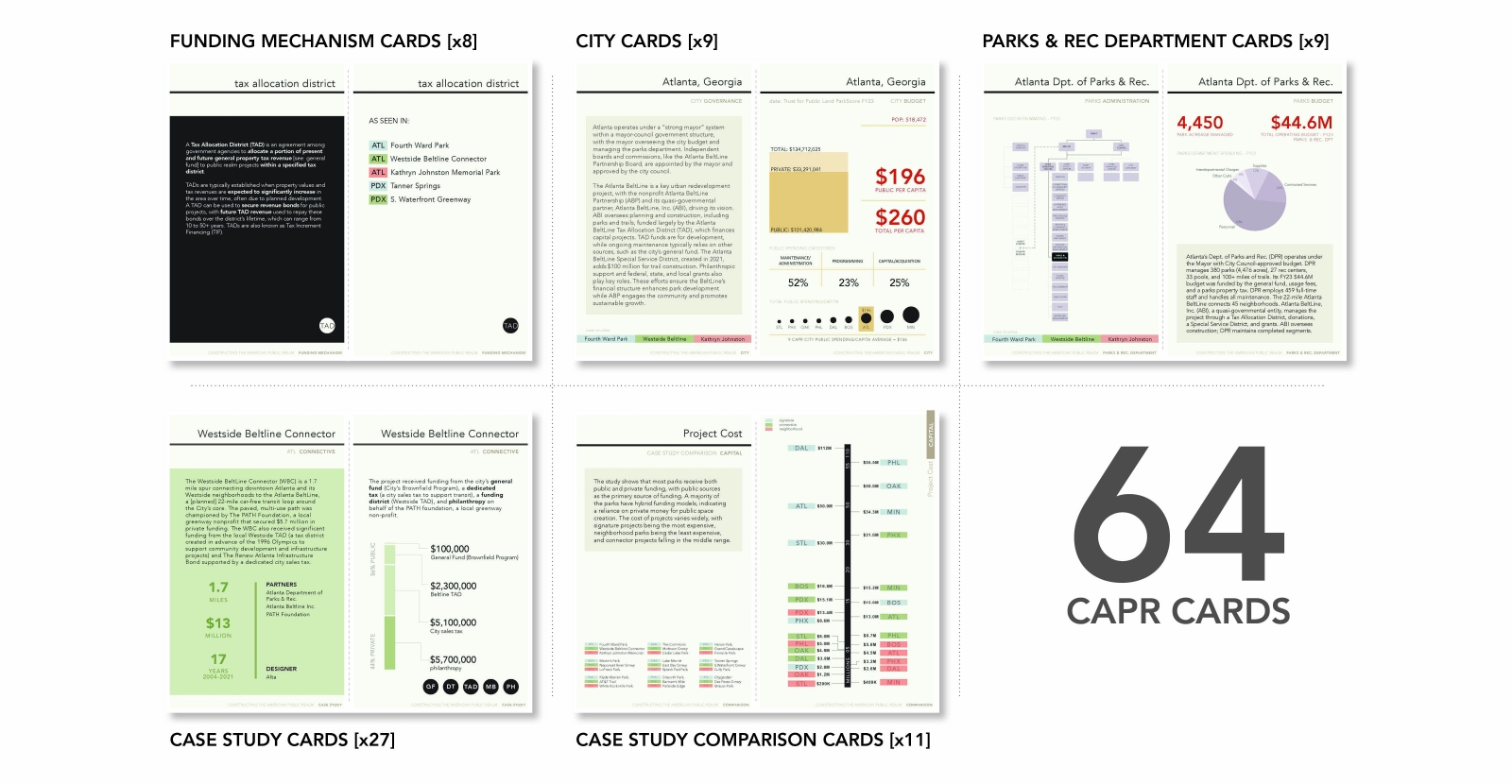
The research project “Constructing the American Public Realm” (CAPR), initiated by Christopher Marcinkoski at the McHarg Center and in ongoing collaboration with the team at PORT Urbanism, examines how Public space is conceived, funded, built, and administrated across nine American cities. CAPR focuses on capital structures and governance models, creating a framework to compare municipal strategies on creating and operating public space, revealing idiosyncrasies in how these processes and investments are deployed. This research led to the creation of a 64-card Public Space Funding Primer—a tool designed to distil complex funding models, governance structures, and investment mechanisms into an accessible format so that people can better understand how public space is made and managed. The cards allow designers, policymakers, and community members to ask “How did other cities get these projects done? How are they paying for this work and structuring projects for long-term success?” CAPR aims to better support advocacy and informed decision-making around the public realm, both in and beyond the design profession.
CAPR has been made publicly accessible through PORT’s design practice and has been presented to professional associations that focus on the built environment and public realm including the National Mayors’ Institute on City Design, the National Recreation and Park Association, the American Institute of Architects, and the American Society of Landscape Architects.
Christopher Marcinkoski sat down with his research assistant and PORT collaborator Lillia Schmidt (MLA ‘25) to discuss this ongoing work.